
„You Must Prevail“
Austrian Poet Konstantin Kaiser on Chernivtsi, Literature of Exile, and the Mission of Poets in a Time of Global Catastrophes
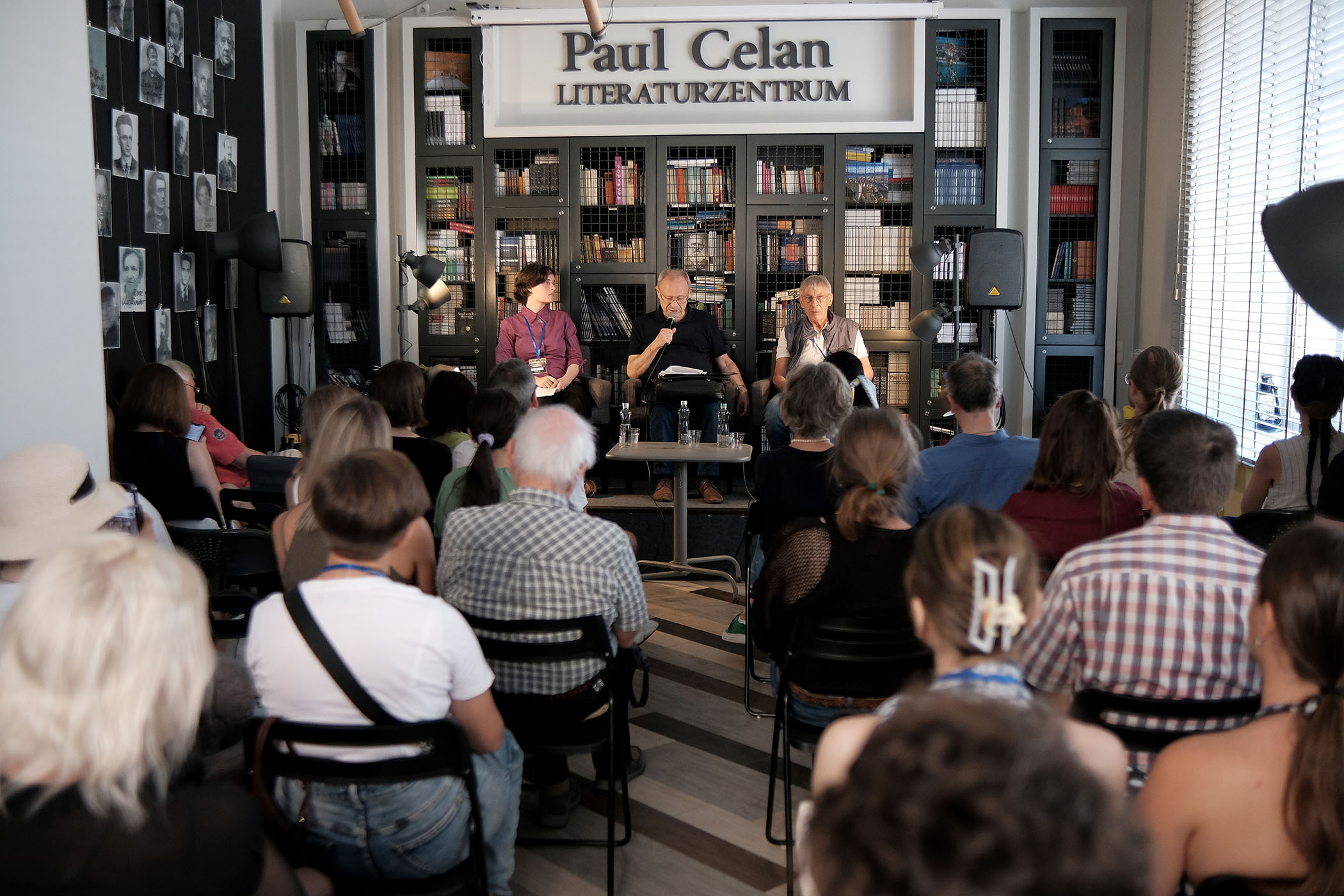
Das Interview mit Konstantin Kaiser erschien am 7. September 2026 in Ukrajinska Pravda und wird im Folgenden in englischer Übersetzung wiedergegeben.
This past weekend, Chernivtsi hosted the Meridian Czernowitz festival, which, as has become tradition, brought together not only Ukrainian writers but also guests from Germany, Austria, Switzerland, and other countries.
Among the guests and participants in the program was Konstantin Kaiser, an Austrian poet, a longtime scholar of emigration, the editor of the most comprehensive anthology of Austrian poets in exile, and a co-founder of the Theodor Kramer Society, which promotes awareness of literature from 1933–1945.
Can a poet afford to “bury his head in the sand” when war is raging? What is the mission of a writer in exile? And why, upon returning home, does he often find no place in the central literary canon?
Arina Kravchenko, literary critic for UP.Culture, visited Chernivtsi, a city that has made an enormous contribution to German-language literature, and spoke with Konstantin Kaiser about the connection between the city and its poets, the literature of exile, a writer’s responsibility in turbulent times, Austria’s imperial past, and why some in Austria still do not understand the Ukrainian resistance.
This conversation was recorded with the support of the Meridian Czernowitz International Literary Corporation and the organizers of the Meridian Czernowitz Festival.
Mr. Konstantin, you’ve done a great deal of work on German-language literature produced outside of Germany and Austria. We’re speaking in Chernivtsi—a city with a rich German-language heritage. What place do texts written in Chernivtsi occupy in German-language literature?
I have been studying German-language literature in exile for decades. In particular, literature related to the Nazi persecution of Jews. And, of course, I also engage with Ukrainian literature. So for me, this is a very complex and broad question.
An integral part of any discussion of German-language literature in exile is, of course, Bukovinian literature. One cannot overlook the well-known Rosa Ausländer, a leading local German-language poet of Jewish descent, or Paul Celan, one of the most important German-language poets. But there were also figures who are much less well-known today—such as Leo Katz.
As for its distinctive features, the defining characteristic of Chernivtsi literature is not that its representatives engaged in any experiments with language, but that they defended it. German, as spoken in Chernivtsi, was not spoken in other regions.
In other words, writers from Chernivtsi did everything they could to ensure that the language they spoke here would continue to thrive; they did not resort to overly radical changes—even though after World War I, a German-language cultural and literary magazine called “Der Nerv” was published here, showcasing the achievements of the Expressionists.
Even Celan, in my opinion, wasn’t much of an experimentalist—at least not the early Celan. He simply gave his poetry very different forms. It was as if he were walking throughout literature. He stood near something beyond which lay an abyss, where the boundary of poetry lay.
Here I see a connection with the Austrian poets in exile—those who left Austria after the National Socialists came to power: the exiles defended their language. Yes, they were perhaps Futurists and Expressionists, but they did not view their own language critically.
Let’s talk in more detail about this defense of the German language in exile. How exactly does poetry defend itself?
Let’s take the aforementioned Rosa Ausländer as an example. She, like some other writers, was forced to stay in the United States. There she began writing in English and only returned to German in the 1960s.
And it was precisely when she returned that she suddenly began writing in “pure” German, though she used a different form. She could certainly be called an experimentalist, because she managed to transform the language—she was particularly skilled at finding new syntactic constructions.
Later on, Celan followed this same path. They did everything they could to ensure that syntax took center stage.
This focus on syntax—and, more broadly, the so-called “search for language”—is something we’ve been talking about frequently in Ukraine since the start of the full-scale invasion. But for Ukrainian poets, this search often goes hand in hand with a certain sense of mission—to convey something, to find a way to name something. Did those writers and intellectuals in exile, whom you’ve studied, think in terms of a mission? Preserving the language, yes, but was there anything else?
I think that, generally speaking, the main mission of poets and writers is to open their eyes and observe closely what is happening. Moreover, those who write must not only keep their own eyes open but also use their poems to open the eyes of others. To a certain extent, a poet’s poems are his or her eyes.
But even today in Austria, unfortunately, there are writers who choose to bury their heads in the sand. There are those who, for example, have the same opinions as Sahra Wagenknecht, an ultra-left-wing populist politician—I’ll refrain from naming these people.
And what happens to a poet who buries his head in the sand? Can such a poet be a good poet?
But what do people see then? Just his backside. That’s a joke, of course.
A poet who buries his head in the sand is no longer a poet. Not burying it in the sand, looking at the world, observing—that’s the bare minimum he can offer. Serhiy Zhadan, by the way, wrote very well about this.
Moreover, it’s worth not only observing what’s happening around you but also trying to extend your attention further. I also write poetry, and I’m deeply influenced by the situation in Ukraine. It resonates in my poetry. For example, “Zbruch” published my poetic cycle dedicated to the war, translated by the Ukrainian poet, translator, and literary scholar Halyna Petrosaniak.
This approach—opening others’ eyes—brings to mind certain Russian poets. Although they have left Russia, judging by their numerous interviews, they very often speak first and foremost—and exclusively—about seeking refuge in their own “self” from everything that the dictatorship threatened them with.
The principle itself is generally sound. The question is what exactly they see, whether they harbor any illusions, and whether they have truly managed to bid farewell to “great Russian culture.” And for them, this is very difficult. For the most part, they remain under the strong influence of their own culture. They continue to be its bearers.
Let’s talk about literary canons. How difficult is it for exiles to return to the canon of their own literature?
Very difficult. Rosa Ausländer herself never returned to the canon. She remained on the sidelines. She was something of an outsider. Such artists are doomed to remain on the border, on the edge.
In other words, there are two canons: the central one and the canon of exiles. Take the Austrian poet Theodor Kramer, for example. Forty years ago, no one even remembered who he was, despite a fairly extensive body of work, including some very good pieces. Does culture really not need such a brilliant writer? Such a rare example of a deeply socially engaged writer? We don’t have much good social poetry, and Kramer is undoubtedly the best.
The thing is, Kramer spent eighteen years in exile. But that doesn’t mean Austrian culture could afford to marginalize such figures. That’s why I compiled a major anthology— ‘The Lexicon of Austrian Literature in Exile’—which includes over seven hundred Austrian poets. I wanted to showcase this diversity to as wide an audience as possible.
Are you satisfied with the results of your work in this field?
No, I’m still far from satisfied.
Why is the process of returning so complicated?
National Socialism weighed heavily on them—the conditions under which people had lived for many years. People change. People go through different experiences. They need different answers to the situations they face in life. You can’t step into the same river twice.
Of course, this does not mean that the literature created in exile was irrelevant. It remained relevant aesthetically. It was contemporary, modern. At times, it remains so even today. After all, anti-Semitism is by no means a problem of the past. The “past” never truly passed, even though the so-called “new era” began after 1945: a course toward the restoration of the national economy, political life, and the Austrian nation itself. After the devastating impact of National Socialism, Austria practically ceased to exist. The nation needed to be rebuilt.
And in Ukraine today, one sometimes hears the view that the “new era” began in 2022, when the achievements gained after 1945 were finally undermined. How close is such a view to modern Austria?
Officially, of course, we condemn this horrific war. In reality, however, many people in Austria do not understand why Ukraine is resisting and defending itself. They do not understand that when Ukraine defends itself, it is a matter of freedom, democracy, dignity, and national pride. Historically, due to our own imperial past, we rejected the “national” ambitions of the Czechs, Slovaks, Hungarians, and others. In other words, this lack of understanding has its roots in the days of Habsburg rule. Supposedly, there are “great” countries, “great” rulers, “great nations,” and then there are all the others. And of course, Russia is “great.” Unfortunately, many Austrians have been “raised” with this mindset.
What needs to be done to change this “upbringing”?
You must prevail. History leaves its mark. And history is often a very complicated matter. It is difficult to change.